Measured, then published
Nine figures, and which of them are targets
A resort on a dune in the Alentejo has two hard constraints: water in July and sand that moves. Everything on this page is one of those two problems, the plant that answers it, and the meter that says whether the answer worked.
- Dune under restoration
- 11.4 ha
- Own generation
- 756 kWp
- Irrigation from recycled water
- 41%
- First full reporting year
- 2026
The method
Metered, not asserted
2026 is the first calendar year in which the whole estate was open. These are its numbers.
Every figure below comes off a meter, a weighbridge ticket, a delivery note or a survey, and each one names where it comes from. Where a number is a target rather than a reading, it says target. That distinction is the only thing that makes the rest of the page worth reading.
Two figures are already uncomfortable and are printed anyway: waste diverted from landfill, which came in at 71% against an 85% target, and the share of planted ground still on irrigation. Both are in the published set with the arithmetic behind them.
The set is published each March for the previous calendar year. Phase 3 adds four villas in 2027 and Phase 4 adds twenty-four houses by 2028, so the per-guest figures will move and the restated series will show it rather than quietly rebasing.
- 214 l
- water drawn per guest-night, 2026
- 56%
- of electricity used came off our own roofs
- 11.4 ha
- of dune replanted by hand since 2023
- 68%
- of produce by weight from within 60 km
Water
Two boreholes, and everything else used twice
There is no mains water here. Two boreholes, drilled to 112 metres in August and October 2023, supply the whole estate; abstraction is metered and reported monthly, and the estate drew 58 400 m³ in 2026. Divided by occupied keys that is 214 litres a guest-night, against a target of 180 by 2028.
Greywater from all 88 keys and from the spa is treated in a plant behind the earth bund and returned to irrigation — 31 200 m³ of it in 2026, which covered 41% of what the planting drank. Pool backwash is not discharged: it settles, is filtered and goes to the same irrigation ring, adding 2 100 m³ a year. Rainwater off 1 900 m² of hard standing runs to a 340 m³ tank and contributes about 1 100 m³.
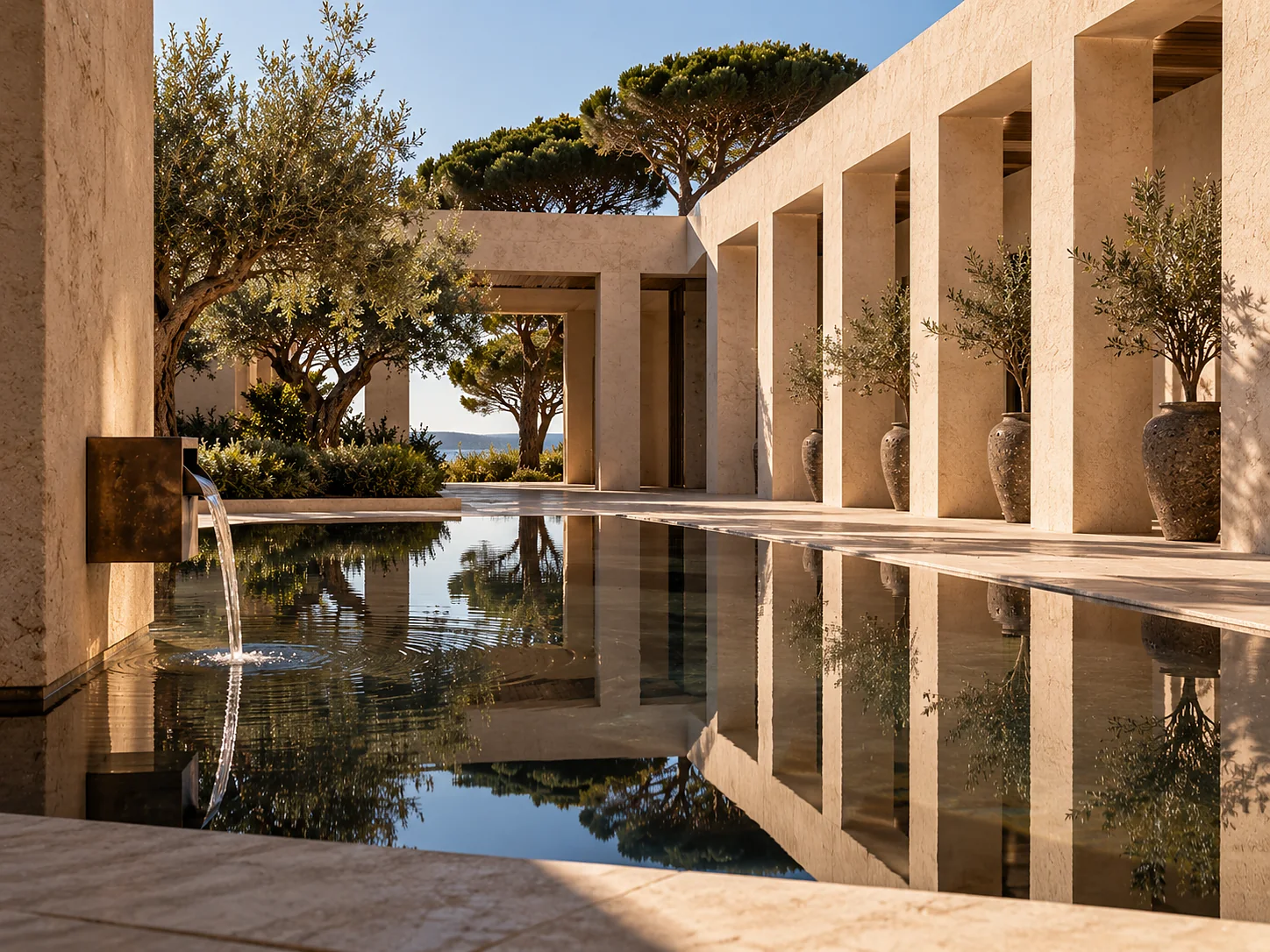
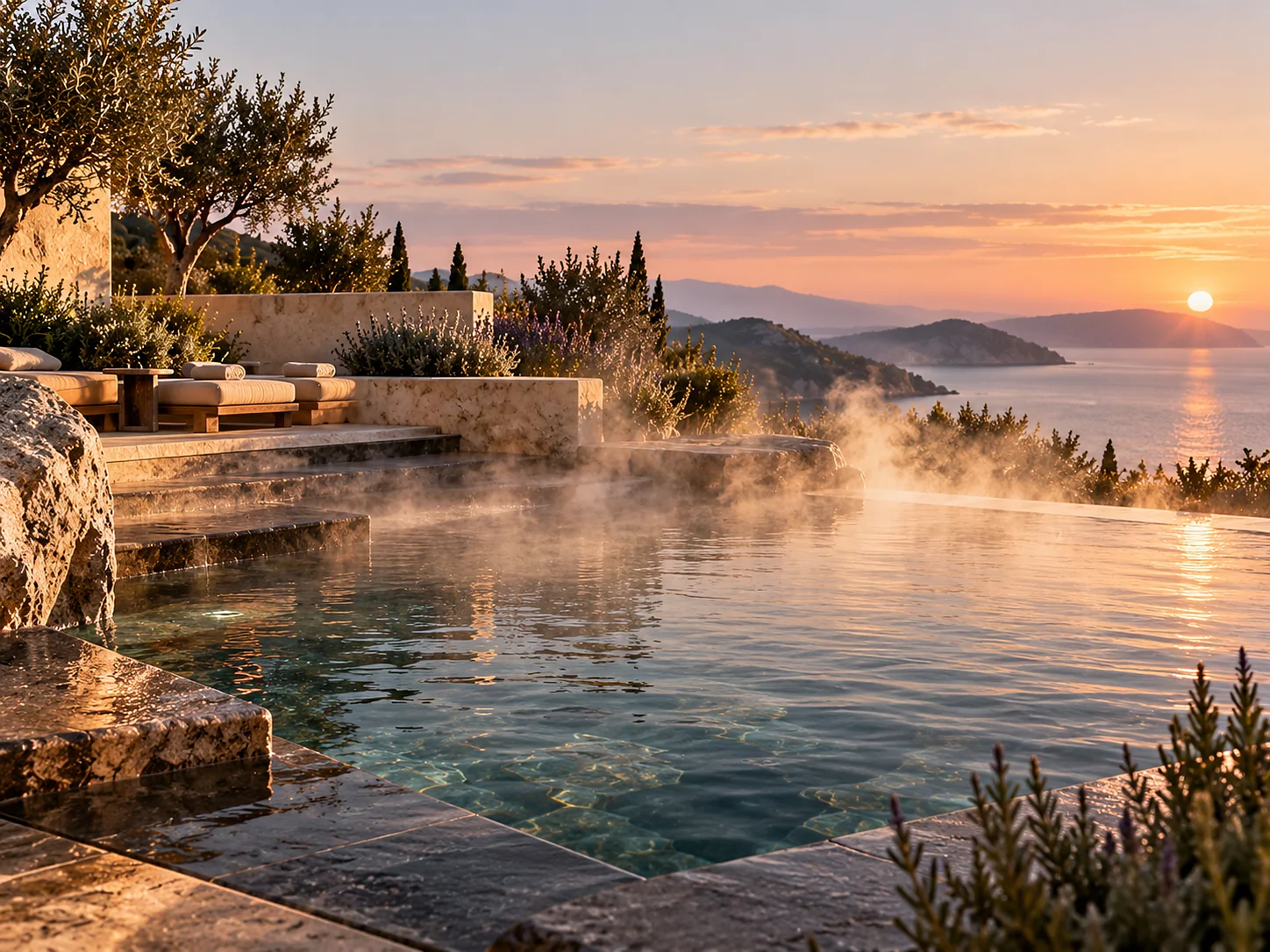
The nine bodies of water hold 2 155 m³ across 1 715 m² of surface, and that surface evaporates roughly 7 900 m³ a year on this coast. Thermal covers go on the lap pool and the children's pool between 23:00 and 07:00 and take about 2 200 m³ of that back — the single largest water saving on the estate, from two covers and a timer.
- Boreholes
- 2, to 112 m
- Drawn, 2026
- 58 400 m³
- Greywater returned
- 31 200 m³
- Backwash reclaimed
- 2 100 m³
Water, as operated
The water balance
| Measure | Figure | Source |
|---|---|---|
| Abstraction, 2026 | 58 400 m³ | Borehole meters, read monthly |
| Per guest-night | 214 l | Abstraction divided by occupied keys |
| Greywater treated and reused | 31 200 m³ | Treated-water meter at the plant |
| Share of irrigation from recycled water | 41% | Irrigation ring meters |
| Pool backwash reclaimed | 2 100 m³ a year | Settlement tank meter |
| Rainwater harvested | about 1 100 m³ a year | 340 m³ tank, level logger |
| Water surface and volume | 1 715 m² · 2 155 m³ | As-built record |
| Evaporation from that surface | about 7 900 m³ a year | Make-up meter, net of backwash |
| Saved by night covers | about 2 200 m³ a year | Make-up meter, covered against uncovered nights |
| Pool turnover | 4 hours | Plant-room design, verified at commissioning |
| Irrigation window | 03:30–06:00, drip only | Controller log, 22 stations |
| Potable water used on the dune itself | 0 litres | The restoration is rain-fed by design |
| Planted ground taken off irrigation | 6.2 of 9.1 ha | Controller log; a zone comes off after its third summer |
Irrigation runs at night because drip emitters lose a measurable fraction of their output to evaporation in Alentejo afternoon air, not because it is tidier. The 22 stations are driven by soil-moisture probes, so a wet week costs nothing to notice.
Energy
The building does most of it before the plant starts
The pavilions sit on an axis 28° west of south, which is not the prettiest orientation and is the right one: the 3.40 m loggia shades the full height of the glass from 1 May to 12 September between 11:00 and 17:00, and lets the low winter sun straight onto the floor slab. That slab and the 300 mm walls give a decrement delay of about 11 hours, so a room carries the night's cool into the middle of the afternoon.
High-level openings on both sides of every pavilion are driven by the building management between 23:00 and 06:00 whenever the outside air is 4 K below the inside. In the three months to September 2026 that purge did the cooling on 58 nights without the compressors running at all.
What is left is electric. Four water-to-water heat pumps on the borehole return give 1 240 kW thermal at a measured COP of 4.6 on pool duty and 3.8 on domestic hot water. Heat recovery in all 88 keys runs at 86% sensible efficiency and clawed back 318 MWh in 2026.
Generation is 1 644 photovoltaic panels at 460 W — 756 kWp — on the service yard and the vehicle canopies, with 1 200 kWh of battery storage. None of it is on a planted roof: the roofs are the reason the estate cannot be seen from the ridge, and that was not for sale.
- Array
- 756 kWp, 1 644 panels
- Storage
- 1 200 kWh
- Heat pumps
- 1 240 kW, COP 4.6
- Heat recovery
- 86% sensible
Energy, as operated
Where the electricity came from in 2026
| Measure | Figure | Source |
|---|---|---|
| Consumed by the estate | 1 878 MWh | Incoming meters |
| Generated on site | 1 164 MWh | Inverter logs |
| Generated and used on site | 1 046 MWh | Inverter and incoming meters, netted |
| Share of consumption self-generated | 56% | 1 046 of 1 878 MWh |
| Exported to the grid | 118 MWh | Export meter |
| Target self-generated share, 2028 | 75% (target) | Second array, 310 kWp over the Phase 3 and 4 canopies |
| Array | 756 kWp · 1 644 panels at 460 W | As-built record |
| Battery | 1 200 kWh, discharging to 600 kW | As-built record |
| Heat pumps | 4 units, 1 240 kW thermal | As-built record |
| Measured COP, pool duty | 4.6 | Plant-room heat and electricity meters |
| Measured COP, domestic hot water | 3.8 | Plant-room heat and electricity meters |
| Heat recovered by ventilation | 318 MWh | MVHR duct sensors, 88 keys |
| Nights cooled by purge alone | 58 of 92, July–September 2026 | Building management log |
| Colour temperature on the estate | 2 700 K, nothing above 3 000 K | Lighting schedule |
| Illuminance at the dune crest, new moon | 0.4 lux | Meter at three fixed points |
Every service on the estate is electric, which is why one number — the self-generated share — answers for the whole carbon question rather than being one line of several. The 2028 target depends on a second array over the Phase 3 and Phase 4 canopies, which is consented and not yet installed.
The dune
Five kilometres of moving ground
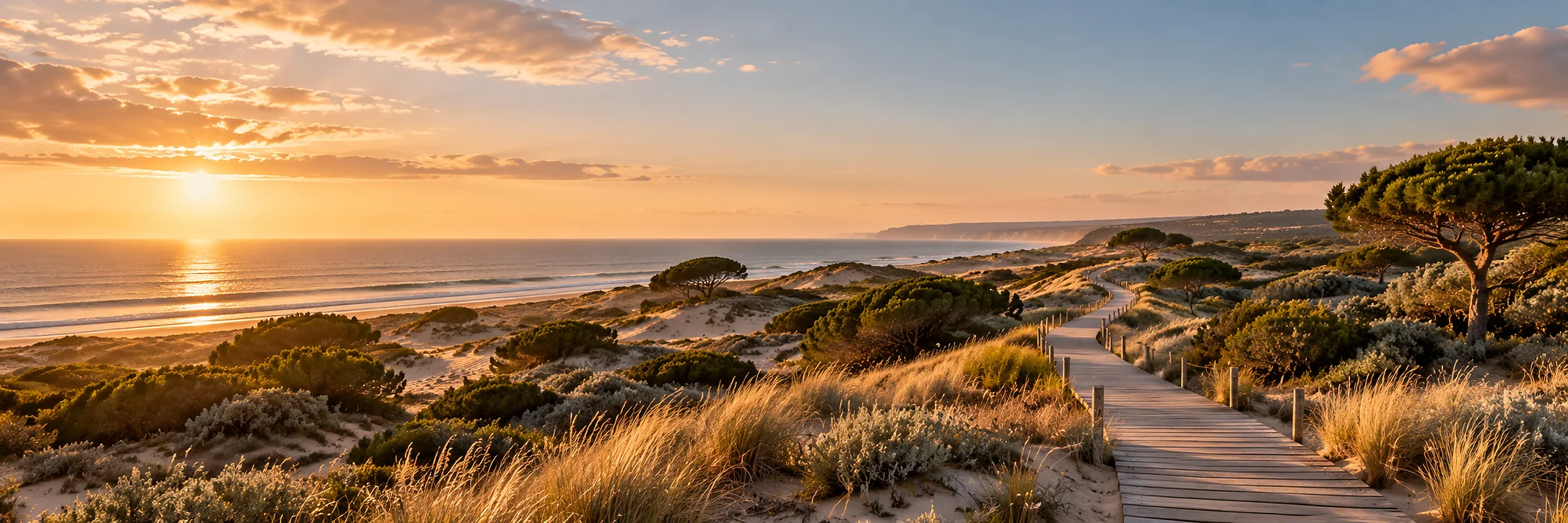
The dune ridge between the estate and the Atlantic is about 5 kilometres long, and 11.4 hectares of it fall inside the boundary. It is the one part of the site that is alive in the engineering sense: it moves, it loses its crest to a winter storm and it rebuilds if the marram holds.
So the restoration began in November 2023, before the first pavilion, and it is the only line on the construction programme that runs past the last phase. 184 000 marram plants have gone in by hand over five seasons, with 2 400 metres of chestnut sand fencing in fourteen runs set across the prevailing north-westerly to catch sand and hold it where the crest wants to be.
Every walk to the beach goes over one of seven boardwalk crossings — 1 180 metres of decking, milled from the same maritime pine boards that shuttered the concrete. Eighteen fixed transects are surveyed twice a year; across their mean the crest stands 0.34 metres higher than at the first survey in 2023, against a target of 0.60 metres by 2028.
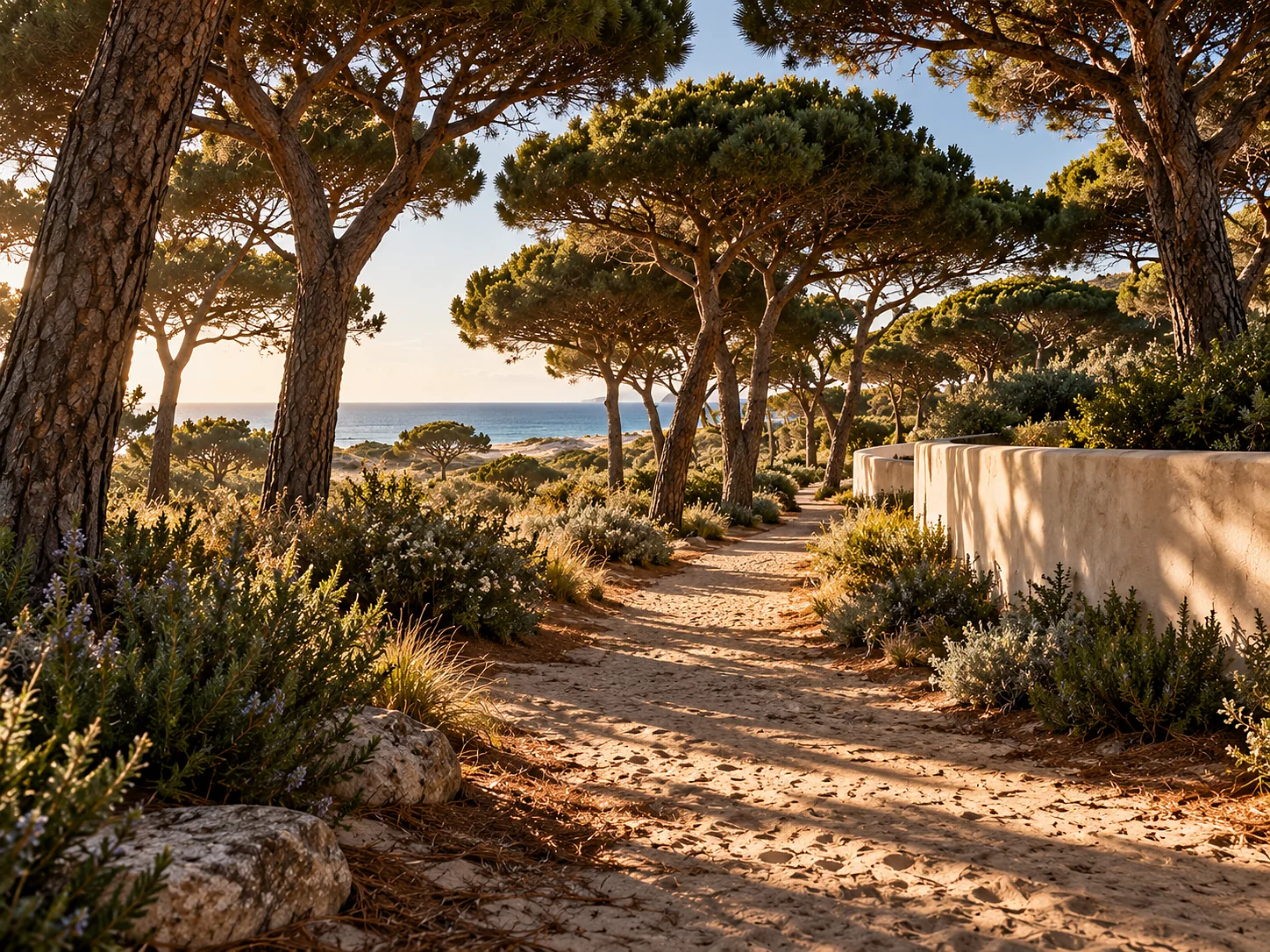
Of the 1 900 pines surveyed before a line was drawn on this site, 1 889 stand today; the eleven taken out for the access spur are in the bar counter and the reception joinery. 240 young pines have gone in to close the age gap in the stand.
- Dune in the boundary
- 11.4 ha
- Marram planted
- 184 000
- Sand fencing
- 2 400 m
- Crest gain since 2023
- 0.34 m
Ground and planting
What is growing, and where it came from
| Measure | Figure | Source |
|---|---|---|
| Estate | 47 ha | Title plan |
| Dune under restoration | 11.4 ha | Survey |
| Pine woodland retained | 1 889 of 1 900 surveyed trees | Tree survey 2022, re-walked 2026 |
| Pines planted | 240 | Planting record |
| Pines removed | 11, for the access spur | Consent discharge; milled into the bar and reception joinery |
| Marram planted by hand | 184 000 over five seasons | Planting record |
| Chestnut sand fencing | 2 400 m in 14 runs | As-built record |
| Boardwalk crossings to the beach | 7 crossings · 1 180 m of decking | As-built record |
| Planted roof | 3 840 m², 11 species | As-built record |
| Species across the estate | 34, all propagated within 60 km | Nursery delivery notes |
| Shrubs planted | 6 800 — cistus, lavender, rosemary, juniper, thrift | Planting record |
| Dune monitoring | 18 fixed transects, surveyed twice a year | Survey file, 2023 onward |
| Crest level, mean of transects | 0.34 m above the 2023 baseline | Survey file |
| Target crest level, 2028 | 0.60 m above baseline (target) | Restoration programme |
Marram is planted by hand because a machine compacts the sand it is trying to stabilise. Five seasons of twelve people with dibbers is the whole technology, and it is the reason the crest is higher than when we arrived.
Waste, in seven streams
Glass, metal, paper and card, plastics, organics, cooking oil, and bulky or construction waste. Seven bins behind every kitchen and every housekeeping station, weighed at the service yard, with the weighbridge tickets kept because a diversion rate nobody can audit is a slogan.
In 2026, 71% of the estate's waste was diverted from landfill against a target of 85% by 2028. The gap is almost entirely mixed plastics and the back end of Phase 3 construction, and both are named in the published set rather than averaged away.
14.2 tonnes of food waste was composted on the estate and went back into the planting. 3 100 litres of cooking oil left for processing. Linen is held in eleven grades and repaired on site; 2.4 tonnes reached the end of that cycle and was cut down for rags rather than replaced wholesale.
Guest rooms have no single-use plastic bottles because the estate's water is treated to drink and supplied in returnable glass from the LUMAR bottling bench — 36 200 litres of it in 2026, filled and washed 1.2 km from where it is poured.
Food, and how far it travelled
68% of produce by weight came from within 60 kilometres in 2026, and 91% from within Portugal. The figure is taken off delivery notes rather than estimated, which is why it is 68 and not 70.
Fish is bought off the Sines and Setúbal fleets, two to seven landings a week depending on the swell, and the boards at BRASA and MIRANTE are written after the fish arrives rather than before. When the Atlantic closes for a week, the menu says so.
The kitchen garden runs to 0.8 hectares at the north of the estate, 41 varieties, and supplies the market table at A CASA from May to October. Beef and lamb come from two Alentejo producers inside 40 kilometres. All of the bread, pastry and chocolate is made in the LUMAR bread room.
The cellar holds 640 references, of which 402 are Portuguese and 118 come from the Alentejo and the Península de Setúbal. That is a sourcing decision as much as a list: the shortest supply line in the building is also the one the sommelier can walk.
The published set
Nine figures, every March
The 2026 column is measured. The 2028 column is a target and is labelled as one. Every figure traces to our own meter, ticket, delivery note or survey, and the fourth column says which — printed at this level of detail so that it can be argued with.
| Figure | 2026, measured | 2028, target | How it is measured |
|---|---|---|---|
| Water drawn per guest-night | 214 l | 180 l | Borehole meters divided by occupied keys |
| Irrigation supplied from recycled water | 41% | 60% | Treated-water and irrigation ring meters |
| Electricity used that the estate generated | 56% | 75% | Inverter logs against incoming meters |
| Heat-pump COP at pool duty | 4.6 | 4.8 | Plant-room heat and electricity meters |
| Waste diverted from landfill | 71% | 85% | Weighbridge tickets, seven streams |
| Produce from within 60 km, by weight | 68% | 75% | Delivery notes, audited quarterly |
| Planted ground off irrigation | 6.2 of 9.1 ha | 9.1 of 9.1 ha | Irrigation controller log |
| Dune crest above the 2023 baseline | 0.34 m | 0.60 m | 18 fixed transects, surveyed twice a year |
| Illuminance at the dune crest, new moon | 0.4 lux | 0.4 lux or lower | Meter at three fixed points |
Published each March for the previous calendar year, with the earlier years restated beside it. 2026 is the first full year the whole estate was open; Phase 3 adds four villas in 2027 and Phase 4 adds twenty-four houses by 2028, and the per-guest figures will move when they do.
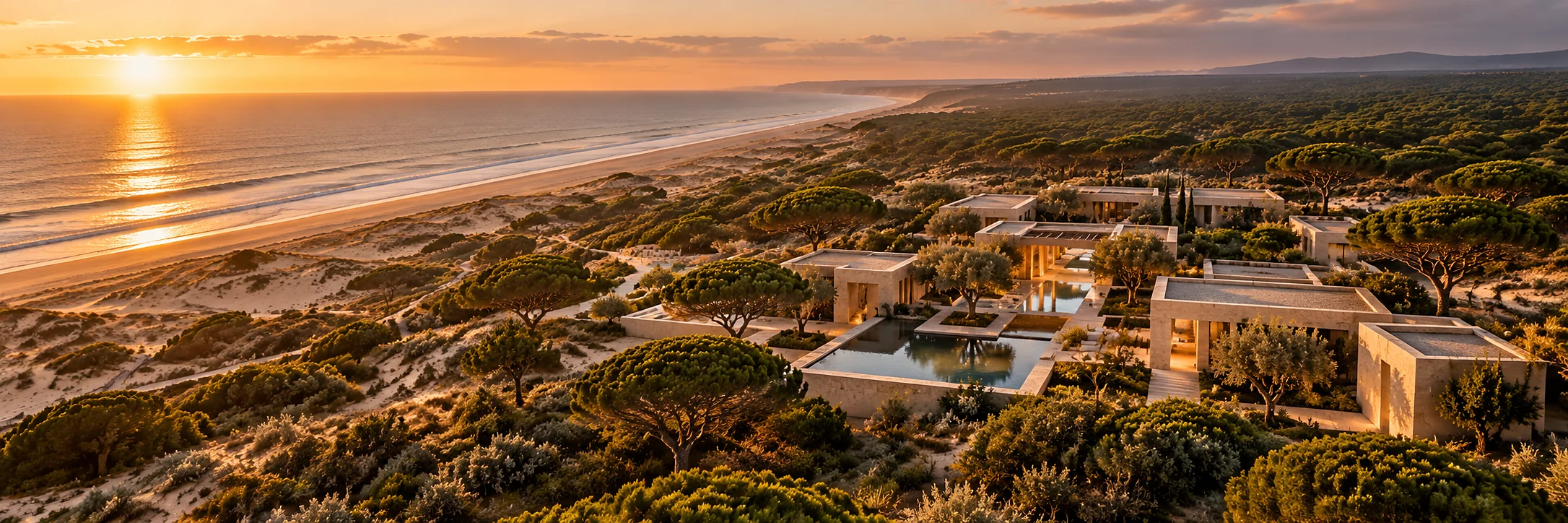
The construction file behind every figure on this page
The boreholes, the heat-pump ring, the 410 mm roof build-up and the programme that put the dune restoration ahead of the first pavilion are all published, with the trades who did the work credited by discipline.