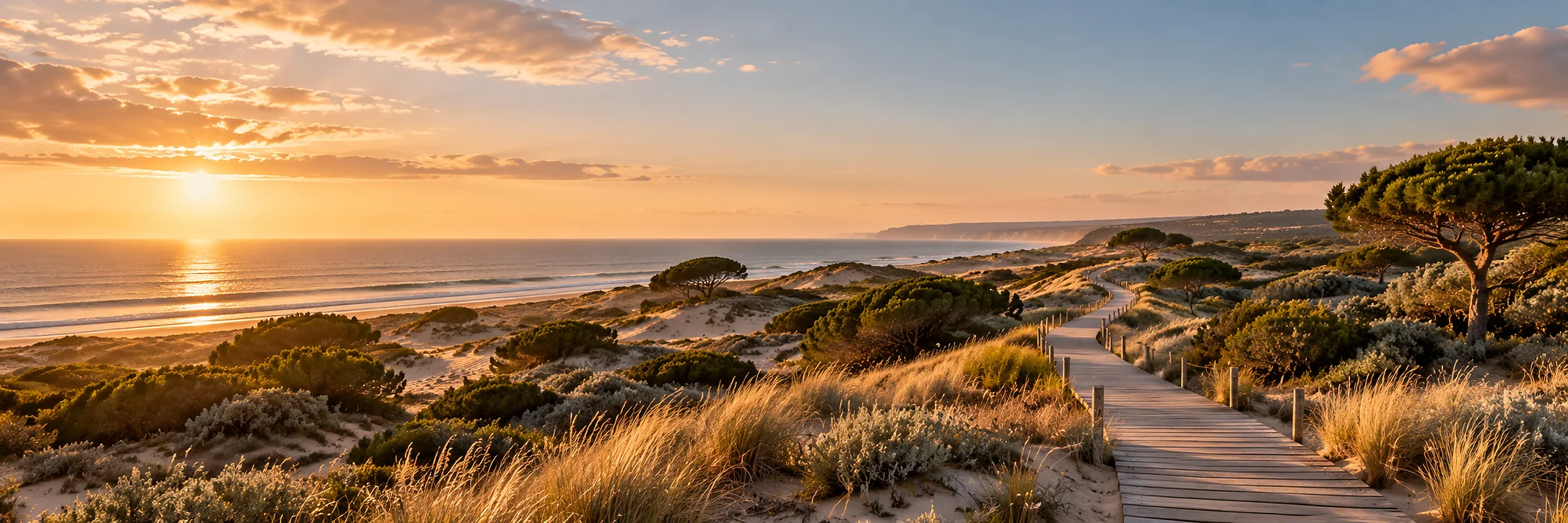
The estate programme
Half of this is only possible for part of the year
Cork is cut from mid-May to August. Rice is sown in April and taken in late September. Salt is lifted at noon in July. Pine cones come down in the winter. The programme follows that calendar rather than ours.
- Experiences
- 14, in four groups
- The farthest
- 46 km from the gate
- On foot from the door
- Five of them
- Seasonal
- Eight of the fourteen
What this is
A working coast, booked by the hour
This stretch of the Alentejo is not scenery. It is a cork forest, a rice basin, a salt estuary and a fishing coast, all of them still being worked, and all of them within an hour of the gate.
So the programme is built out of what is actually happening. In July you can stand in a montado 18 km inland while a cork cutter opens a trunk with an axe and paints the last digit of the year onto the stripped wood — because the next cut on that tree is nine years away, and the number is how anyone knows. In late September the Sado paddies at Comporta are cut, and in April they are sown and flooded. Neither can be moved to suit a Tuesday in February.
Five of the fourteen start at your own door. The rest need a car for between fifteen minutes and an hour, and we drive you. Nothing on this page is a demonstration arranged for guests: the cork cutter is cutting cork whether or not you come, and the only thing we have arranged is that you are allowed to stand there.
Prices are per person and indicative. Service is included, and the four experiences run by our own people carry no mark-up at all.
- 14
- experiences in the programme
- 4
- groups, from the dune to a maker's wheel
- 46 km
- the farthest, at the salt pans
- 10.4 km
- the dune crossing, there and back
- 19 °C
- the Atlantic in September, its warmest
On the estate
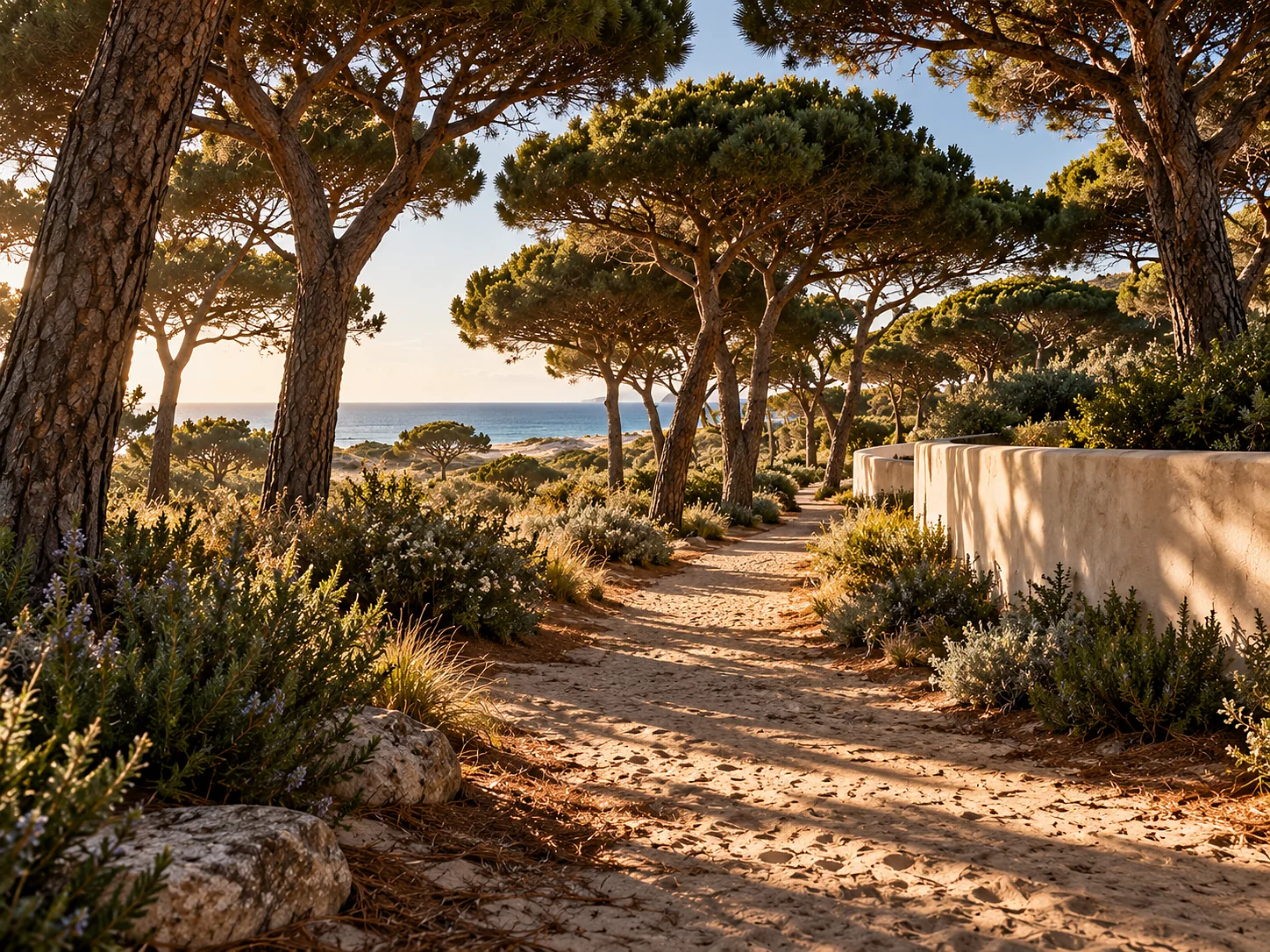
Four of these need nothing but shoes, and two of them happen while the rest of the estate is asleep. Five kilometres of dune stand between the pavilions and the tide line, and none of it has ever been built on, which is why it still holds a population — fox, Egyptian mongoose, common genet, badger, and a dune beetle that leaves a track like a zip.
Nothing here is guided by somebody reading from a card. The dune walk is led by the estate's dune warden, who is the person who repairs the marram; the tracking is led by the ecologist who writes the estate's annual habitat report.
- The crossing runs twice a day: 06:40 and 18:00 from April to September, 08:00 and 15:00 from October to March
- 10.4 km there and back, with 164 m of cumulative climb over soft sand — harder than the distance reads
- The nearest street light is 6 km away at Melides, which is why the sky works
- Umbrella pine cones take three years to ripen, so a winter harvest is a harvest of 2023
The Dune Crossing
The whole width of the dune: 5.2 km out to the tide line, the same back, barefoot for the last stretch if you want it, led by the warden who repairs the marram. You can turn at any point, and the warden walks the slowest pair home. One to ten people; tell reception by 20:00 the evening before.
Tracks Before Breakfast
Reading the night off the dune before the wind resets it: fox, mongoose, genet, badger, beetle. The ecologist who writes the estate's habitat report leads it, with the previous week's records in a folder. Two to eight people, 48 hours' notice.
The Pine Nut Morning
The estate's own stand of umbrella pine, the long pole, and the slow business of getting a kilo of nuts out of a basket of cones. A kilo is roughly fifty cones and about forty minutes of cracking. Two to ten people, 72 hours' notice.
Night Sky from A Crista
The ceremony deck on the ridge, a 150 mm reflector, and no light within 6 km. September to April because the nights are longer and the air is drier. Blankets and a flask from LUMAR. Two to twelve people, 48 hours' notice.
On the water
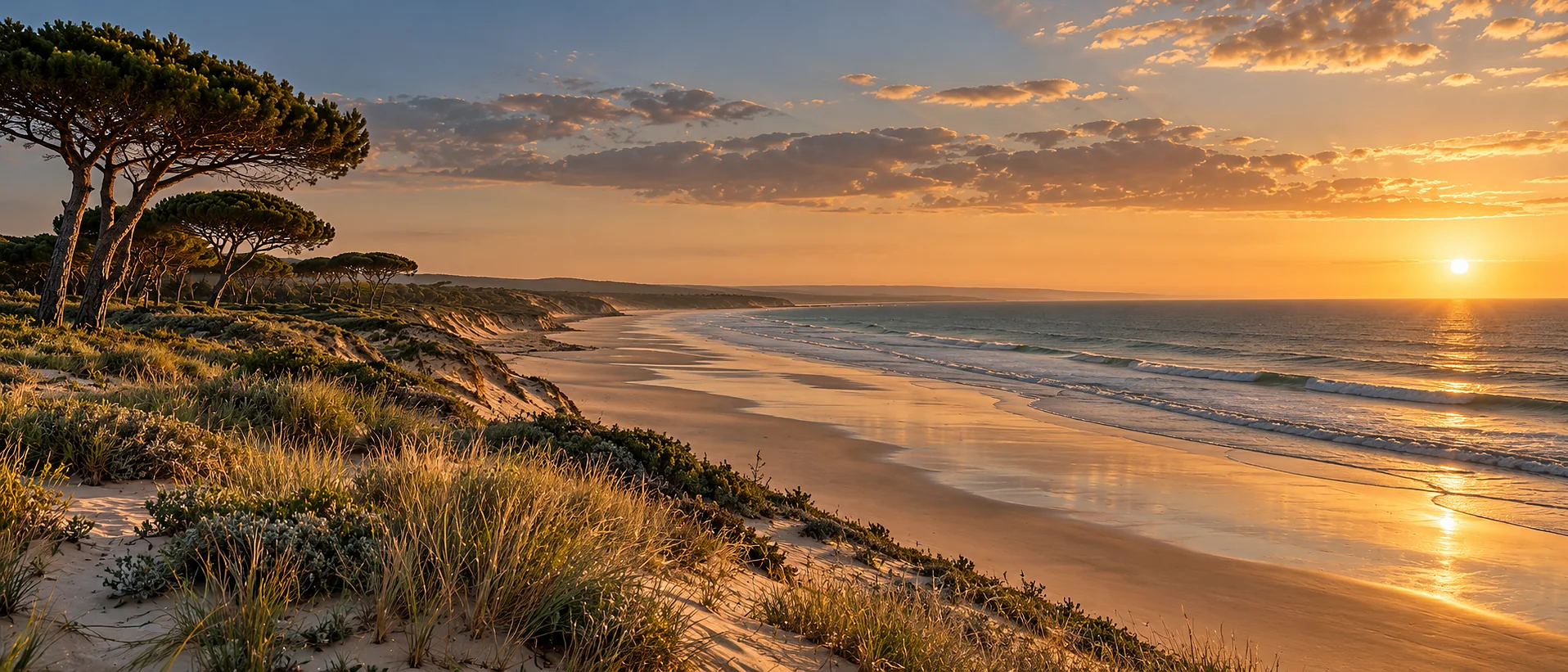
The Atlantic in front of the estate is 15 °C in February and 19 °C in September, and the swell arrives from the north-west for most of the year. That is the reason the resort has nine bodies of warm water, and it is also the reason the water programme is honest about wetsuits: 4/3 from November to May, a shorty in August.
Behind the beach the water goes quiet. Lagoa de Melides is a coastal lagoon with 3.1 km of shoreline that the sea breaks into most winters and closes again by June. Thirty-eight kilometres north the Sado estuary holds a resident population of roughly thirty bottlenose dolphins, which is one of very few resident groups on this coast.
- Sea temperature: 15 °C in February, 17 °C in June, 19 °C in September
- Wetsuits: 4/3 from November to May, 3/2 in June and October, a shorty in August
- Every water experience is called by the skipper or the instructor by 18:00 the evening before
- A call-off is refunded in full, the same day, with nothing to claim
The Lagoon on Flat Water
A paddleboard on water that does not move, along 3.1 km of reed and sand shoreline, with the sandbar at the sea end to walk over. Herons, and in spring the storks that nest on the pylons behind the lagoon. One to eight people, 24 hours' notice.
The Sado Dolphins
Out of the estuary mouth with a licensed skipper into the water the resident group uses — roughly thirty animals, present year-round, which is why nobody promises a sighting and the skipper will tell you the odds that morning. Two to ten people, five days' notice.
Beach Break at First Light
A beach break with a sand bottom and nobody on it at seven in the morning, two instructors to six people, boards and wetsuits brought down by the instructors rather than carried over the dune. First-time or fourth-time; the instructors split the group by what you can already do. One to six people, 24 hours' notice.
The Oyster Punt
A flat-bottomed punt out to the beds at low water with the man who works them, boots on, and eight oysters opened on the gunwale with a glass of something cold. October to April, because that is when the estuary is coldest and the oysters are at their best. Two to eight people, five days' notice.
Inland: cork, rice, salt
Drive twenty minutes east and the dune becomes montado — open cork-oak pasture, which is a farmed landscape that happens to be one of the richest habitats in Europe. A cork oak is stripped for the first time at around twenty-five years old and then every nine years after that, by hand, with an axe, between mid-May and late August when the tree is growing and the bark will come away without tearing the cambium. The last digit of the year goes onto the trunk in white paint. That is the whole record-keeping system, and it works.
North of here the Sado flattens into rice. The paddies at Comporta are sown in April, flooded, and cut in late September, and the dykes between them run for about 25 km. Further up the estuary the salt pans still work the old way: sea water moved through five evaporating stages over roughly twenty-five days, and the flor de sal lifted off the surface by hand with a wooden rake before the afternoon wind puts it back.
- Cork: stripped every nine years, mid-May to late August only, never in a dry year
- Rice: sown April, cut late September; 25 km of dykes at Comporta
- Salt: five stages, about 25 days, flor de sal raked by hand at noon
- Greater flamingos feed on the pans through the summer, which is a reason to go at all
The Cork Cut
Two cutters, one axe each, a tree that was last opened nine years ago, and the sound a cork oak makes when the bark lets go. You will be told not to touch the axe and you will want to. Closed shoes; the montado has ticks in July. Two to twelve people, seven days' notice.
Rice, Sand and Water
April for the sowing and the flooding, late September for the cut, and nothing in between, because in between a rice field is a field of water. Along the dykes on foot, then a plate of the rice itself cooked the way the people who grow it cook it. Two to ten people, five days' notice.
The Salt Pans at Noon
Noon, because that is when the crust forms and the rake goes in, and the heat is part of the explanation rather than an inconvenience to be apologised for. A hat is not optional. Flamingos on the far pans most days in July. Two to ten people, seven days' notice.
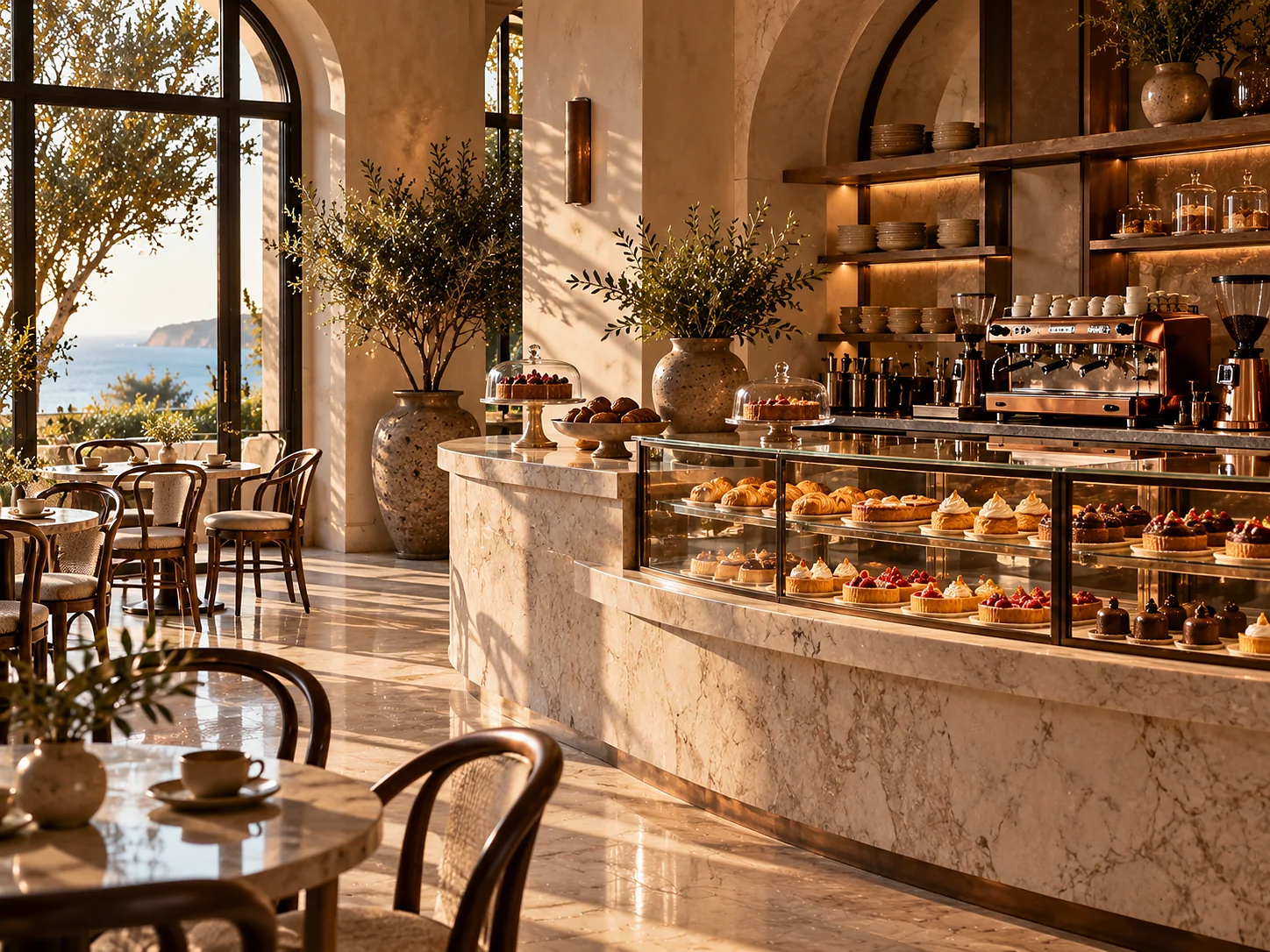
With a maker
Melides has thrown pots for a long time, and still does — there are working wheels 6 km from the gate using clay dug within the district. Fourteen kilometres inland somebody weaves the rush mats that are on the floor of every suite here, which is a fact we would rather you heard from her than from us.
The third maker is ours. LUMAR's bread room starts at five in the morning on a levain that was fed thirty-six hours earlier, and the wood oven goes in at 280 °C and falls through the bake to 230 °C. Six loaves come out at seven, which is when the first guests arrive for coffee, which is the only reason the baker gets up at four.
- The clay is dug within the Melides district; three pieces thrown, one fired
- A fired piece is posted on about six weeks later, at our cost, anywhere
- A rush mat of 600 × 400 mm takes roughly four hours and you take it home
- The bread room is on the estate: 36-hour levain, oven at 280 °C, six loaves at 07:00
Hands in Melides Clay
A half day at a working wheel with a potter who sells what she makes, using clay from the district. Three pieces thrown, the best one trimmed, glazed, fired and posted to you about six weeks later. One to four people, ten days' notice. Not in August, because the studio closes.
The Bread Room at Five
Five in the morning in LUMAR's bread room: the levain that was fed at five the previous evening, the shaping, the oven at 280 °C, and your own loaf out at seven. Breakfast afterwards at the counter, which you will have earned. One to six people, 48 hours' notice.
Rush, Cane and the Floor You Walk On
The weaver who makes the rush mats that are in every suite on this estate, at her own table, with her own reeds cut from the lagoon margin in late summer. One mat of 600 × 400 mm, about four hours, yours to carry out. One to five people, seven days' notice.
The whole programme
Fourteen experiences, compared
Duration, party size, season, the notice we need and the indicative price per person. Filter by a word, a month or a number.
| Experience | Where | Duration | Party | Season | Notice | From, per person |
|---|---|---|---|---|---|---|
| The Dune Crossing | On the estate | 2 h 30 | 1–10 | All year, twice daily | By 20:00 the day before | Included |
| Tracks Before Breakfast | On the estate | 75 min | 2–8 | All year | 48 hours | €45 |
| The Pine Nut Morning | On the estate | 2 h | 2–10 | December to March | 72 hours | €60 |
| Night Sky from A Crista | On the estate | 90 min | 2–12 | September to April | 48 hours | €70 |
| The Lagoon on Flat Water | Lagoa de Melides, 7 km | 2 h | 1–8 | April to October | 24 hours | €85 |
| Beach Break at First Light | Praia da Aberta Nova, 9 km | 2 h | 1–6 | All year | 24 hours | €95 |
| The Oyster Punt | Sado beds, 38 km | 3 h | 2–8 | October to April | 5 days | €150 |
| The Sado Dolphins | Sado estuary, 38 km | 4 h | 2–10 | All year, best May to September | 5 days | €190 |
| Rice, Sand and Water | Comporta, 22 km | 3 h | 2–10 | April and late September | 5 days | €95 |
| The Cork Cut | Montado near Grândola, 18 km | 3 h | 2–12 | Mid-May to late August | 7 days | €110 |
| The Salt Pans at Noon | Upper Sado, 46 km | 2.5 h | 2–10 | June to September | 7 days | €85 |
| The Bread Room at Five | On the estate, LUMAR | 2.5 h | 1–6 | All year | 48 hours | €95 |
| Rush, Cane and the Floor You Walk On | Inland, 14 km | 3 h | 1–5 | March to November | 7 days | €75 |
| Hands in Melides Clay | Melides, 6 km | 4 h | 1–4 | All year except August | 10 days | €220 |
Prices are indicative, per person, and include service, the transfer where there is one, and everything you are handed on the day. The notice column is a minimum rather than a recommendation: the cork cut and the salt pans depend on somebody else's working week, and seven days is how long it takes to ask them. Four of the fourteen are run by the estate's own people, and those four carry no mark-up.
Practical
Five things worth knowing before you book
Through the stay planner when you reserve, or by email to [email protected] at any point afterwards, or at reception on the day for anything whose notice period still fits.
A place is confirmed in writing with the meeting point, the time, and what to bring. Nothing is charged until the experience has happened, and it goes on the room.
The four water experiences are called by the skipper or the instructor by 18:00 the evening before, on the forecast rather than on optimism. The crossing runs in anything short of a storm, because the dune is more interesting in bad weather.
A call-off is refunded in full on the same day. There is nothing to claim and nobody to chase, and we will offer the next window that works before you ask for it.
Most of it, with ages set by the activity rather than by policy: the dolphins from 6 in a buoyancy jacket, surf from 8, clay from 8, the lagoon from 10, the dune crossing from 10, the cork cut from 12.
The bread room takes a child of any age who will get up at half past four, which is a smaller number than parents expect.
The Dune Crossing, twice a day, every day. The four surveyed running routes on the estate, and the trail notes for them. Everything else on this page is charged at the indicative figure in the table.
Service is included in every figure, here and everywhere else on this site, and no service charge is added at the end of anything.
Four are ours: the crossing, the tracking, the pine nuts and the bread room. The other ten belong to the people who do them for a living — a skipper, two surf instructors, an oyster farmer, two cork cutters, a rice grower, a salt worker, a potter and a weaver.
We book them, we drive you, and we pay them their own rate. We do not ask them to change what they are doing so that it reads better.
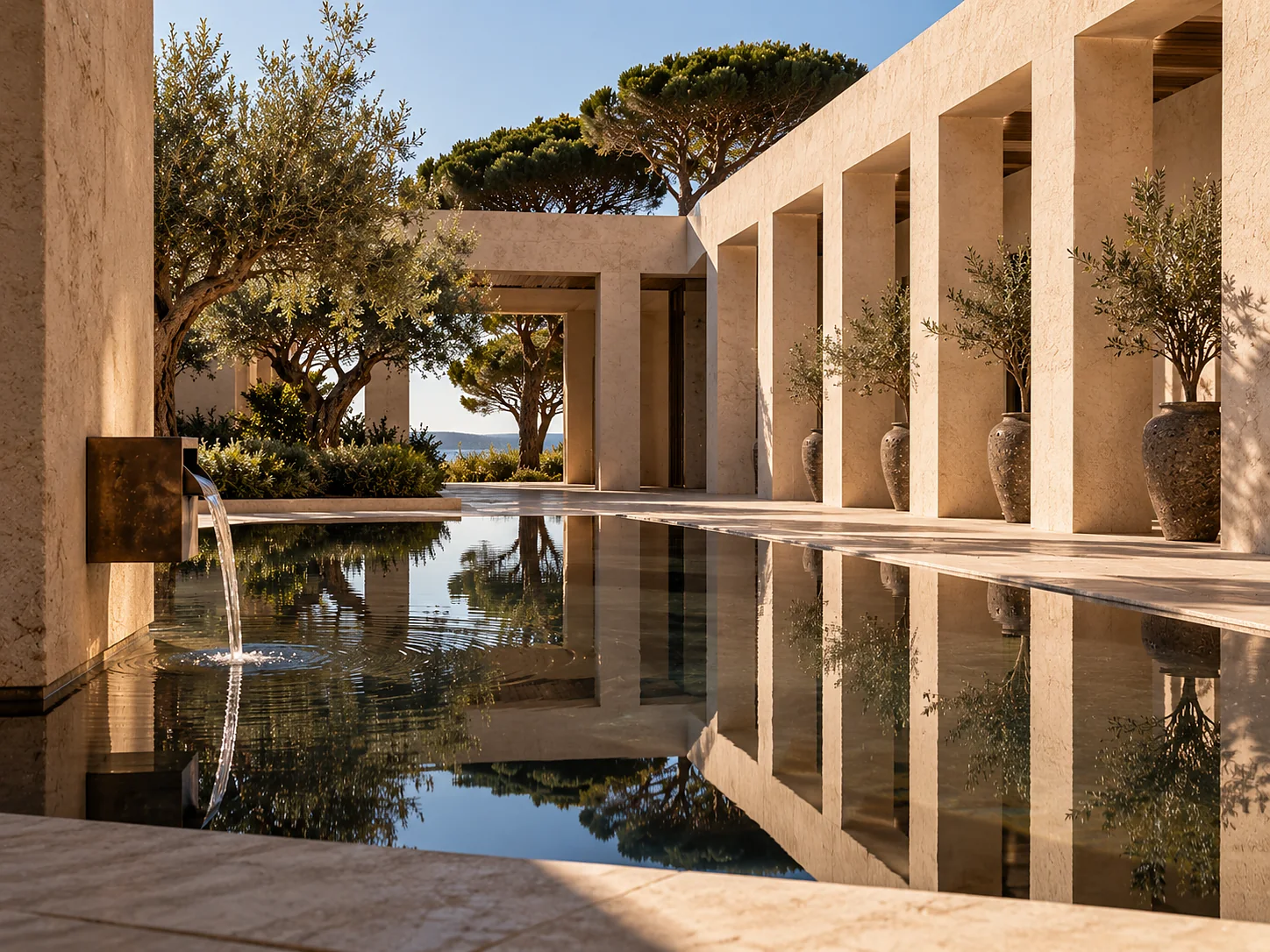
Seven months of the year the Atlantic is 15 °C
Which is why the estate has nine bodies of water and 1 715 m² of surface, a thermal pool held at 34 to 36 °C all year, and a cold plunge at 12 °C for anyone who misses the sea. The programme on this page is what you do between swims.